
Judge the campaign comparison by conversion and efficiency
What the review found
The source table shows ACoS of 15.72% for the earlier campaign group and 20.84% for the later group. Conversion was 21.91% versus 13.90%, while CPC was lower in the later group.
 Enlarge image
The two source cohorts show conversion of 21.91% versus 13.90% and ACOS of 15.72% versus 20.84%. Their time windows are not normalized, so this is a diagnostic comparison rather than a causal before-and-after result.
Original audit image.Open full sizeWhy it matters commercially
Cheaper clicks do not help enough when fewer visitors order. The comparison points to a traffic-quality or conversion investigation rather than a simple objective of reducing CPC.
Recommended next move
Align campaign cohorts and reporting windows before quantifying change. Examine query relevance, landing products and product readiness in the weaker group.
Stop treating every placement as equally valuable
What the review found
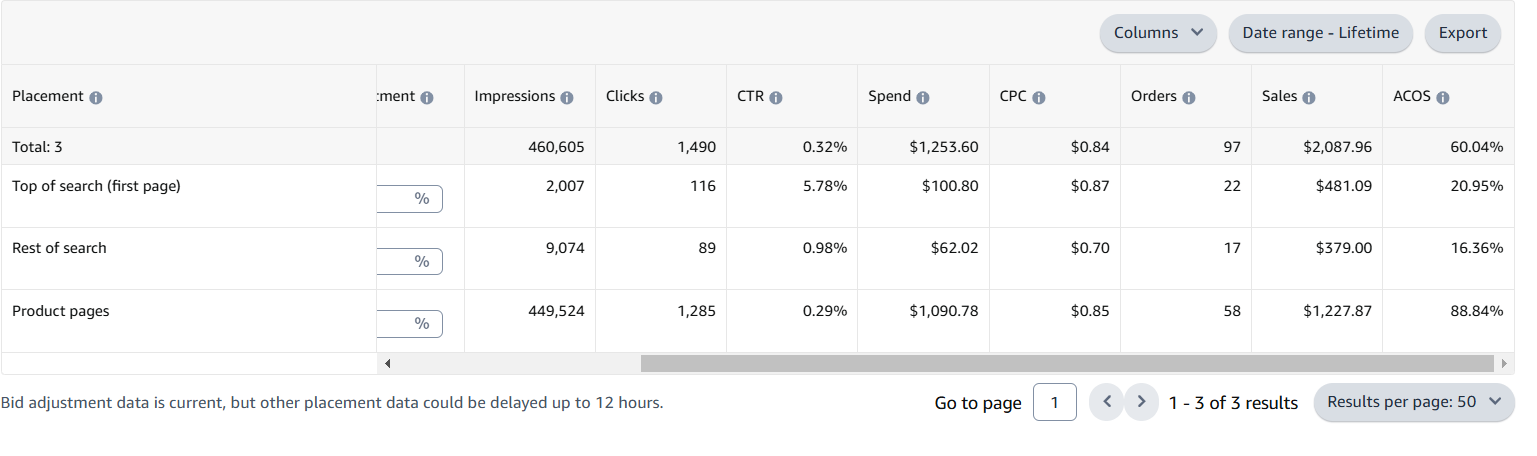
The campaign notes describe examples with large spend concentrations on expensive placements. One example had roughly 90% of campaign spend on a placement near 88% ACoS; others paired efficient Top of Search with much weaker alternatives.
 Enlarge image
Source console excerpt, with the account and campaign header omitted. Product pages use $1,090.78 of $1,253.60 spend at 88.84% ACOS. The screenshot’s date selector is Lifetime; it should not be merged with shorter reporting windows.
Excerpt from the original audit image; identity columns or headers omitted.Open full sizeWhy it matters commercially
Campaign totals can conceal where the loss originates. A campaign-level budget increase may send more money into the weakest exposure rather than into the converting placement.
Recommended next move
Inspect placement performance within each material campaign. Adjust weak exposure and test productive alternatives while checking conversion volume, margins and attribution timing.
Correct brand-defense targeting that attracts the wrong intent
What the review found
The audit identified a short brand-related term that also referred to an unrelated business in another category. The relevant longer query converted, while the ambiguous broad target consumed spend.
Why it matters commercially
A campaign labeled brand defense can still buy irrelevant traffic. Its name does not prove that the audience is searching for the advertised product.
Recommended next move
Separate the relevant longer query from the ambiguous broad target. Review the actual matched queries and apply precise exclusions where irrelevant traffic is established.
Build an optimization loop after campaign launch
What the review found
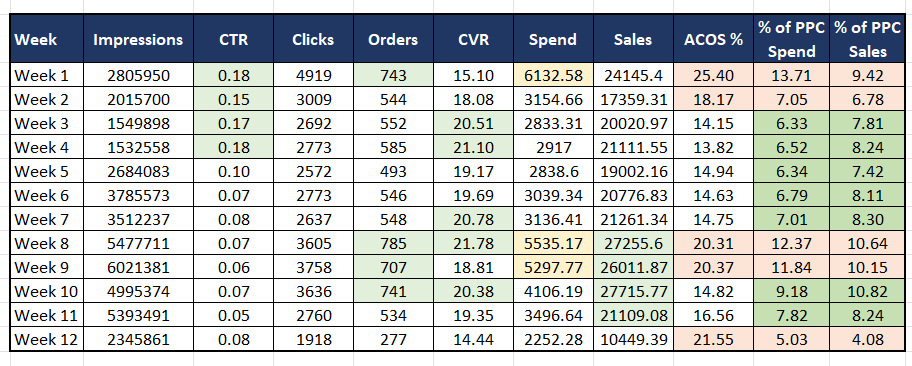
The report repeatedly flags search terms with clicks but no orders, missing negative targeting and campaigns left running on weak placements. It describes inadequate follow-up after launch.
 Enlarge image
The original twelve-week table compares clicks, orders, spend, sales and ACOS. It supports monitoring the effect of decisions over time, while accounting for seasonality, promotions and stock changes.
Original audit image.Open full sizeWhy it matters commercially
Campaign creation without review lets small inefficiencies accumulate. At the same time, a few clicks without a sale do not justify indiscriminate exclusions.
Recommended next move
Set a review cadence based on spend significance, product economics and sufficient evidence. Use targeted negatives and bid changes; avoid broad exclusions that would suppress relevant searches.
Treat product readiness and landing destination as part of PPC
What the review found
The audit found stronger examples using suitable child products and dedicated landing pages. Newer products with little review history were associated with high ACoS.
Why it matters commercially
Even relevant traffic may struggle to convert when the product or destination is a weak match. Raising bids cannot resolve every offer or credibility problem.
Recommended next move
Send traffic to the product most relevant to the query. Review product-page clarity, offer competitiveness and customer-experience signals before scaling newer products.
Use hourly patterns as a test after the core repairs
What the review found
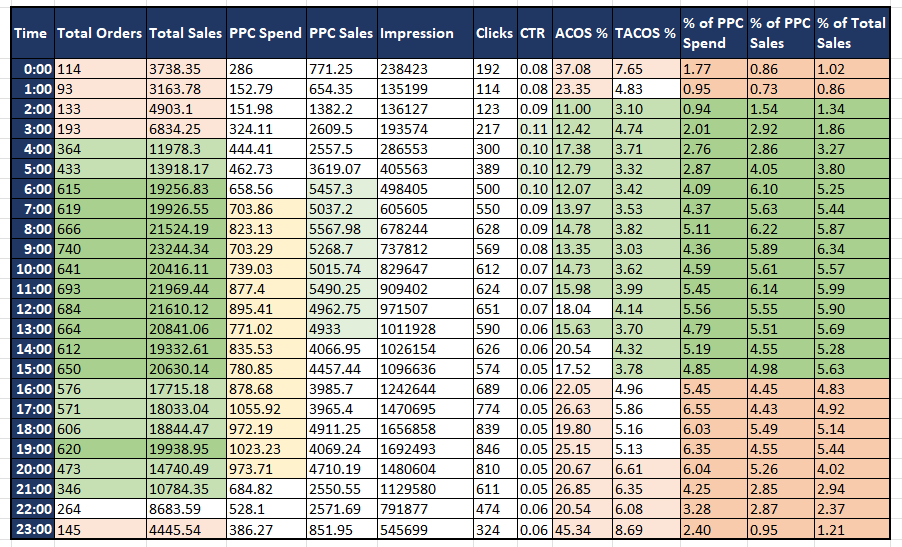
The December 1–28 hourly review identified differing spend-to-sales patterns by hour, and a separate 12-week analysis found inconsistent conversion efficiency. Search Query Performance was unavailable.
 Enlarge image
Hourly table based on December 1–28, 2024. It is a short historical sample for a scheduling hypothesis after core targeting and placement repairs—not a permanent dayparting rule.
Original audit image.Open full sizeEnlarge image The original twelve-week table compares clicks, orders, spend, sales and ACOS. It supports monitoring the effect of decisions over time, while accounting for seasonality, promotions and stock changes.
Original audit image.Open full sizeWhy it matters commercially
A short historical timing pattern does not prove that turning campaigns off at those hours will improve total sales. The audit also could not assess organic query performance directly.
Recommended next move
Confirm reporting time zone, attribution lag and repeatability before a limited scheduling test. Evaluate total orders and efficiency, and obtain query data before making organic-performance claims.