
Check whether the offer can convert at the current price
What the review found
One reviewed product was priced at $38.99, above the sampled competitors’ $8–$19 upper segment. The report described better sales at earlier lower prices.
Why it matters commercially
The gap may reflect differentiation, but it needs a clear value case. A price cut is not automatically more profitable and historical associations do not prove causation.
Recommended next move
Compare materials, pack contents and benefits on a like-for-like basis. Confirm unit economics and test an economically viable offer before materially expanding acquisition.
Control concentration in automatic loose targeting
What the review found
Automatic campaigns received about 90% of spend. Auto loose accounted for 74% of total spend at a reported 53% ACoS.
 Enlarge image
Automatic campaigns receive about 90.8% of spend in this source snapshot. This establishes the concentration in discovery activity; it does not by itself prove automatic targeting should be stopped.
Original audit image.Open full size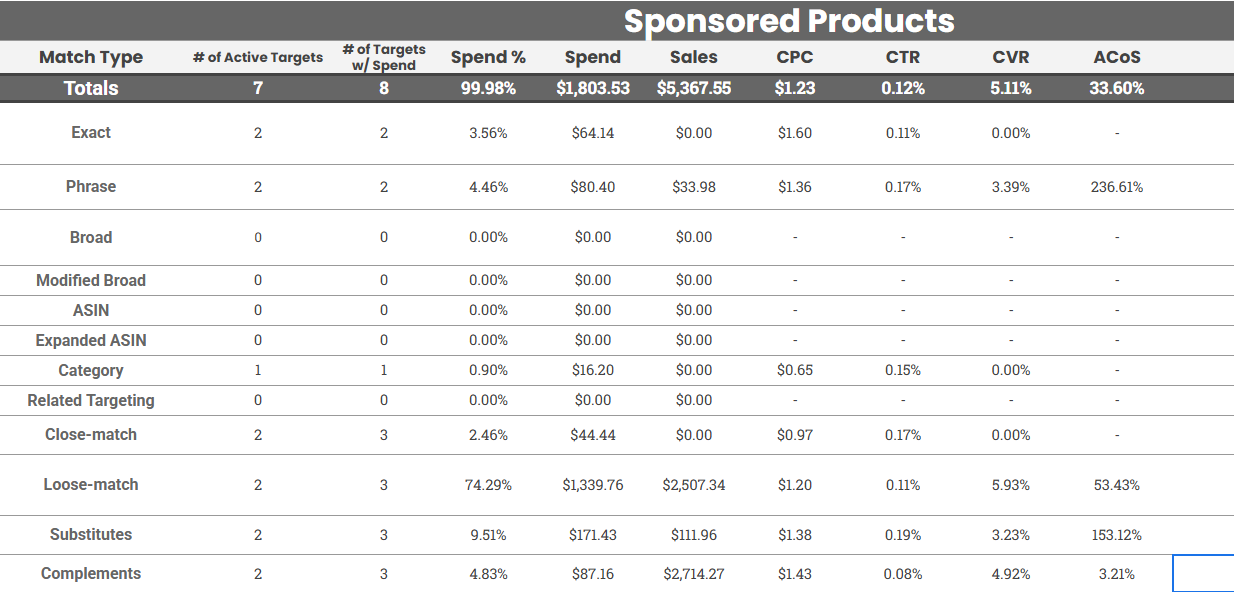 Enlarge image
The original match-type table shows loose-match concentration and limited exact-match spend. Missing or small segments are testing gaps, not demonstrated opportunities with guaranteed returns.
Original audit image.Open full sizeWhy it matters commercially
One discovery route was making most budget decisions for the account. The risk is the concentration and query quality, not automatic campaigns by definition.
Recommended next move
Inspect the matched queries and product relevance. Remove established irrelevant traffic, cap uncertain exploration and retain useful converting discovery.
Revisit the placement imbalance
What the review found
Top of Search had the strongest reported conversion and lowest ACoS but received 11.41% of spend. Product Pages received about 44% and were described as inefficient.
 Enlarge image
Product pages take 44.19% of spend at 168.28% ACOS, while top of search takes 11.41% at 33.98% ACOS in this export. Campaign-level relevance and bid changes need to be tested within the offer’s margin.
Original audit image.Open full sizeWhy it matters commercially
A placement-level mismatch can consume budget that might be better tested elsewhere, although campaign mix may explain some of the difference.
Recommended next move
Review the split within important campaigns. Test selective bid changes with a spending ceiling and monitor total sales, rather than applying an account-wide multiplier.
Develop deliberate manual coverage from query evidence
What the review found
Exact-match spend was only $64 in the reviewed data. The organic comparison found the products represented on only a few of the sampled competitor keywords.
Enlarge image The original match-type table shows loose-match concentration and limited exact-match spend. Missing or small segments are testing gaps, not demonstrated opportunities with guaranteed returns.
Original audit image.Open full sizeWhy it matters commercially
Limited coverage can leave relevant searches unexplored, but exact match does not guarantee ranking gains or superior economics.
Recommended next move
Shortlist relevant queries from conversion evidence and product fit. Use tightly themed tests, preserving the discovery routes that continue to earn their budget.
Keep branded demand and sparse product evidence separate
What the review found
The report described stronger branded conversion for one product and limited Search Query Performance conversion data for another.
Why it matters commercially
Combining them could make a new generic test look more certain than it is.
Recommended next move
Use separate branded and generic objectives. Improve the weaker product’s offer and gather a sufficient sample before expanding its advertising.