
Resolve the mismatch between images and supplied contents
What the review found
The client reported that imagery showing two wheel types caused buyers to assume both were included. Returns followed even though the listing text said otherwise.
 Enlarge image
Category-level returns research in the source document. It supplies context for investigating supplied contents, setup and quality alongside the seller’s own reported return problems; it is not the client’s account-level return rate.
Original audit image.Open full sizeWhy it matters commercially
A visual expectation can outweigh a written qualification. Confusion reduces the value of every new order and creates avoidable returns.
Recommended next move
Make each offer’s included wheels unmistakable throughout supporting content and order selection. Keep accessories and complete products clearly distinguished.
Validate quality and setup before replenishing aggressively
What the review found
The client described a poor replacement-supplier product and later reported uneven wheel inflation and rolling. The discussion also raised instructions and pump quality.
Enlarge image Category-level returns research in the source document. It supplies context for investigating supplied contents, setup and quality alongside the seller’s own reported return problems; it is not the client’s account-level return rate.
Original audit image.Open full size Enlarge image
Niche customer-review topics provide additional questions about quality, ease of use and expectations. Confirm the causes against the reviewed product’s own feedback before choosing a remedy.
Original audit image.Open full sizeWhy it matters commercially
The underlying problem may be physical performance rather than simply marketing. A better image cannot fix a faulty component.
Recommended next move
Inspect representative production units, reproduce reported failure conditions and verify instructions. Use acceptance criteria before accepting or promoting additional stock.
Choose an offer structure the economics can support
What the review found
The initial bundle proposal combined two wheel sets at a high total price. The discussion then considered separate all-terrain and beach-specific offers with optional accessories.
Why it matters commercially
A bundle can clarify value but also increase price, cost and buyer complexity. Competitor comparisons must account for what each package includes.
Recommended next move
Complete a separate cost and margin model for each configuration. Test a limited viable offer before committing to broad inventory expansion.
Treat the differentiation claim as a product test
What the review found
The client proposed larger beach wheels as a solution for difficult sand conditions. The follow-up acknowledged limited competitor review history and uncertain material tradeoffs.
Why it matters commercially
A plausible product gap is not yet proof of reliable demand or performance.
Recommended next move
Run representative use tests and limited inventory validation. Gather honest customer feedback and assess weight, transport and assembly tradeoffs alongside sand performance.
Align stock and advertising with the demand window
What the review found
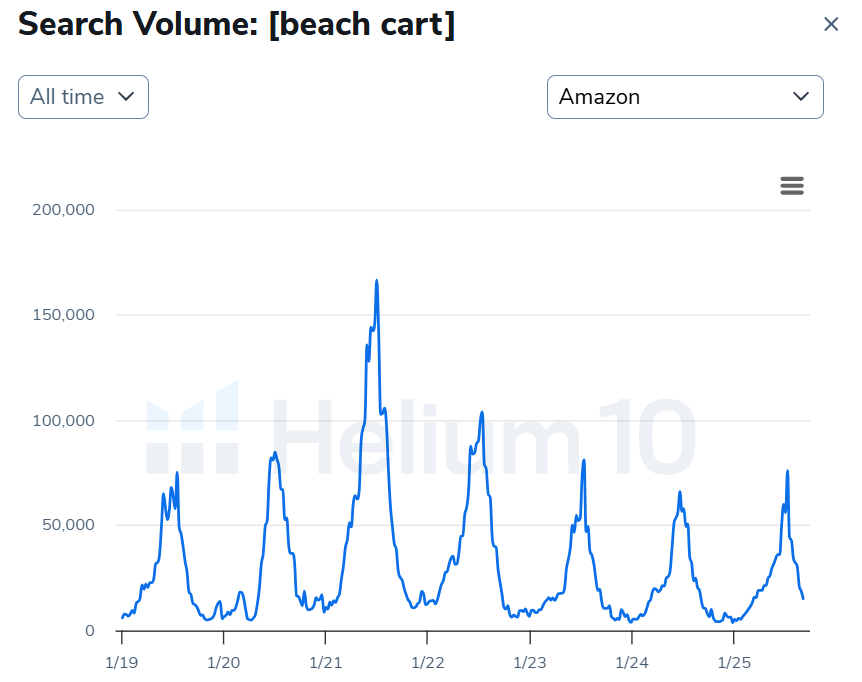
The report discussed seasonal demand and supplier timing but explicitly lacked ACoS and TACoS data. A full PPC review was proposed after account access.
 Enlarge image
The “beach cart” search-volume history shows recurring seasonal peaks. It supports timing an inventory and advertising test; it does not prove demand for an untested wheel or bundle configuration.
Original audit image.Open full sizeWhy it matters commercially
Historical demand does not establish current advertising efficiency. Inventory and campaign plans need separate evidence.
Recommended next move
Obtain current ad and business reports, confirm available stock and model seasonal sell-through. Increase acquisition only after the product and offer pass the earlier checks.