
Independent expertise. Connected Amazon growth.Helping brands grow in the US & Europe
All audit roadmapsBaby essentials · Audit diagnosis

Recover budget capacity before asking winners to scale

START HERE · CORE SUMMARY

Baby essentials

The constraint
Weak search-term segments consumed the capacity to support winners.
The evidence
High-ACoS and zero-order segments used 63.3% of US spend for 7.9% of ad sales.
The first move
Review relevance, attribution and margins before reducing waste and testing proven demand.
Explore the findings
US advertising spend allocation by search-term segmentEnlarge image

US allocation: the high-ACOS and low-click zero-order segments together use 63.3% of spend but contribute 7.9% of ad-attributed sales. Low-click terms require further evidence before exclusions; the source’s profitability labels are not verified net margin.

Original audit image.Open full size
Reporting context & account detail +

Two marketplaces had meaningful revenue but a large share of advertising sat in weak or zero-order search-term segments. The review connected that allocation with the products already carrying sales and the relevant queries where their visibility could improve.

Product focus
Baby socks and cotton muslin blankets, with separate United States and Canada reviews. Product contribution and pack presentation are evaluated alongside advertising allocation.
Scope
US and Canada account economics, product contribution, search visibility and spend allocation
Reporting context
Five-week commercial snapshot; advertising table dates not stated
US weak / zero-order spend
63.3%
7.9% of ad-attributed sales in those segments
Canada weak / zero-order spend
58.2%
3.7% of ad-attributed sales in those segments
US top three parents
82.36%
Share of reported account revenue

4 source visuals · Click any screenshot to inspect the detail

Priority rationale: Protect the economics of the existing business first. Review the largest inefficient spend segments, preserve useful discovery, and direct the next tests toward products that already contribute materially to revenue.

01

Start with the spend-to-sales imbalance

What the review found

The US table places 63.3% of spend in the highest-ACoS and zero-order segments, together producing 7.9% of ad-attributed sales. The equivalent Canada figures are 58.2% and 3.7%.
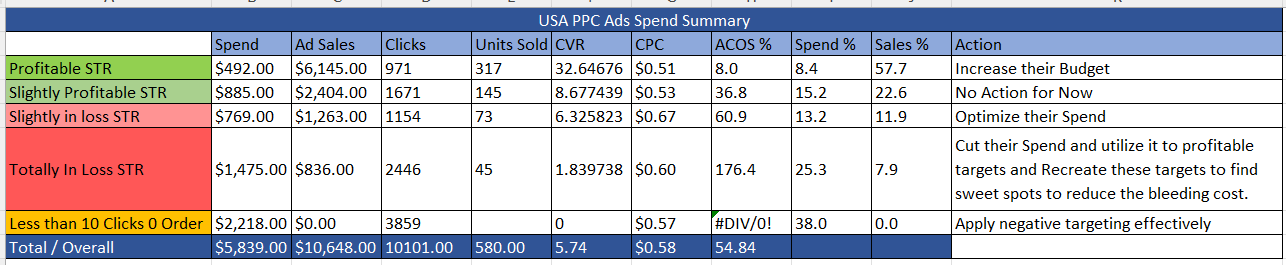
US advertising spend allocation by search-term segmentEnlarge image

US allocation: the high-ACOS and low-click zero-order segments together use 63.3% of spend but contribute 7.9% of ad-attributed sales. Low-click terms require further evidence before exclusions; the source’s profitability labels are not verified net margin.

Original audit image.Open full size
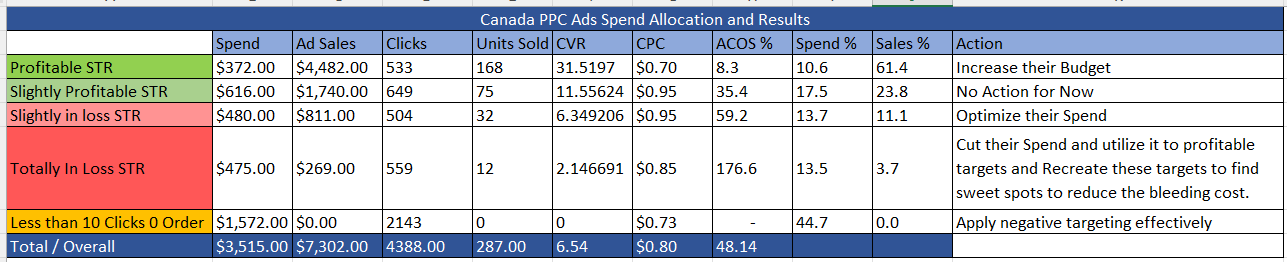
Canada advertising spend allocation by search-term segmentEnlarge image

Canada allocation uses a separate CAD dataset: the corresponding segments consume 58.2% of spend and contribute 3.7% of ad-attributed sales. The same low-sample and margin qualifications apply.

Original audit image.Open full size

Why it matters commercially

This allocation leaves less room to support effective queries. The sales shares describe advertising results, not total account revenue.

Recommended next move

Review relevance, attribution timing and product margins within those segments. Reduce established waste and contain uncertain tests rather than excluding every low-click term automatically.

TrackSpend and ad-sales share by segment; contribution after advertising.
02

Keep a margin constraint around the growth target

What the review found

The commercial brief reports a 25% margin before ads and 19% TACoS. These are stated account assumptions, not a reconstructed profit-and-loss statement.

Why it matters commercially

Revenue growth can consume most of the margin if advertising expands without a product-level cost model. The stated gap is not a verified net-profit percentage.

Recommended next move

Confirm landed cost, fees, returns and the margin definition. Set acceptable acquisition costs for each priority product before increasing budgets.

TrackContribution margin by SKU and total-account TACoS.
03

Prioritize the products that already carry the business

What the review found

Three US parent products contributed 82.36% of reported revenue; two Canada parents contributed 66.50%. The review therefore began with those products rather than the entire catalog equally.
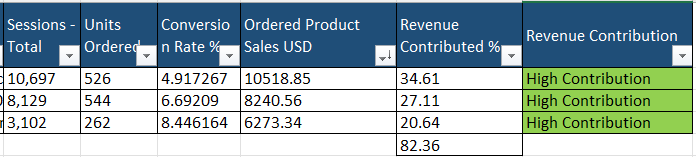
Revenue contribution of three leading US parent productsEnlarge image

Source excerpt: the three leading parent products account for 82.36% of revenue in this table. Identity and title columns are removed; sessions, units, conversion and contribution remain visible.

Excerpt from the original audit image; identity columns or headers omitted.Open full size

Why it matters commercially

Improving the offer or coverage of a major contributor can matter more than polishing many low-volume listings. Concentration also creates stock and demand risk.

Recommended next move

Check inventory and offer readiness on the leading parents. Rank child products by contribution and conversion, then choose the highest-value work first.

TrackParent and child revenue contribution, availability and unit conversion.
04

Turn relevant query gaps into controlled tests

What the review found

The keyword review identified relevant terms where leading products had weak positions or limited advertising support. It separated page-one opportunities from terms further back in the search results.

Why it matters commercially

Relevant demand is a test opportunity, not a guaranteed rank or sales gain. An already converting product offers a clearer starting point than an unproven one.

Recommended next move

Map queries to the appropriate product and test a small set with explicit budgets. Review query purchases, total sales and costs together before expanding coverage.

TrackQuery-level conversion, total purchases, ad cost and organic visibility.
05

Refine offer clarity after the allocation decision

What the review found

The review compared price per unit, pack size and blanket dimensions rather than judging price alone. It also identified main-image and buyer-clarity opportunities.

Baby-sock product image annotated with a packaging-clarity proposalEnlarge image

Original annotated baby-sock image from the review. The packaging suggestion is a proposed test, not an achieved CTR improvement. Any main-image change must accurately show the supplied offer and meet the applicable image requirements.

Original audit image.Open full size

Why it matters commercially

A seemingly expensive offer may include more units or a larger product. If that value is unclear, additional exposure may fail to convert.

Recommended next move

Make included quantity, dimensions and intended use easy to understand. Test the most material creative or offer change on the priority products before a catalog-wide redesign.

TrackClick-through rate, conversion, average selling price and returns.
RECOMMENDED SEQUENCE

The roadmap.
One decision at a time.

Move to the next phase when the preceding constraints are understood and the account is ready.

PHASE 01

Protect the current economics

  • Confirm the reporting windows and margin assumptions.
  • Review high-cost and zero-order search-term segments.
  • Protect inventory and buyability on the leading products.
PHASE 02

Reallocate with evidence

  • Retain productive search terms and bounded discovery.
  • Test relevant coverage gaps on the strongest products.
  • Compare US and Canada decisions separately.
PHASE 03

Validate before expanding

  • Track contribution and total sales alongside ad sales.
  • Test pack-value and product-clarity improvements.
  • Increase investment only where performance and stock support it.

Evidence and interpretation.

The spend tables are historical snapshots with no visible reporting dates. Their profitability labels are segmentation labels, not independently verified SKU margins. Low-click zero-order terms need sample-size and attribution checks. The documents describe opportunities and proposed work, not a completed growth result.

Client and business identities are withheld. Actions describe the proposed work; historical observations do not establish a guaranteed future result.

YOUR NEXT CHAPTER STARTS HERE

Let’s make your next
Amazon move count.

Tell me where you are. Let’s work out where to go next.

Discuss my account with Fahad